A boutique reformer Pilates studio in Brooklyn pays Mindbody $279 a month for the Accelerate plan. On top of that: 3.6% on every online card transaction, a 20% commission (capped at $30) on every booking that comes through the Mindbody consumer app, and $249 a month extra if they want a branded mobile app. Their owner did the math last quarter: roughly $13,000 a year in software costs alone, before payroll, rent, or a single reformer spring replacement.
She's now asking the question every studio owner hits around year three: does the Mindbody marketplace traffic justify the bill? Or would running bookings through Shopify (where her merch and digital programs already live) let her keep that money and own her customer data?
This article walks the actual numbers, the real feature gaps, and the honest tradeoffs of moving from Mindbody to a Shopify-based stack. By the end, you'll know whether the switch makes financial sense for your studio, and exactly how to execute it if it does.
Why studios are rethinking Mindbody in 2026
For two decades, Mindbody was the only serious option for class-based fitness. You paid the bill, you got the marketplace, you didn't think twice. Three things changed that calculus.
First, the price climbed. The platform offers three tiers: Starter at $99/month, Accelerate at $259 to $279/month, and Ultimate at $499 to $699/month. Those prices are per location and exclude payment processing fees and add-ons. For a two-location Pilates business, the base subscription alone can hit $560 a month before a single student checks in.
Second, the marketplace take got harder to swallow. Bookings made through Mindbody's consumer app incur a 20% commission capped at $30, plus standard processing fees. A $100 class booked through the app nets you $76.50 after the combined 23.5% total take.
Third, studios started selling more than classes. Branded merch, on-demand video programs, digital guides, retreat packages, gift cards. None of that sits naturally inside Mindbody. All of it is native to Shopify.
The studios doing this math aren't tech-forward outliers. They're owners who already have a Shopify store for retail and realized they're paying Mindbody for the booking layer alone.
The real cost of Mindbody (line by line)

The advertised price is the small number. Here's the full P&L for a single-location boutique studio doing $25,000 a month in revenue, 70% from online card transactions:
Cost line | Monthly | Annual | Notes |
|---|---|---|---|
Base subscription (Accelerate) | $279 | $3,348 | Per location |
Card processing (online, 70% of $25K) | ~$650 | ~$7,800 | 3.60% + $0.30 per online txn |
Card processing (in-studio, 30% of $25K) | ~$250 | ~$3,000 | 2.99% + $0.30 per txn |
Marketplace commission (15 first-time bookings/mo at $25 avg) | ~$75 | ~$900 | 20% capped at $30/booking |
Branded app add-on (optional) | $249-$299 | ~$3,300 | Not included in any base plan |
Subtotal without branded app | ~$1,254 | ~$15,048 | |
Subtotal with branded app | ~$1,530 | ~$18,360 |
Now compare a Shopify stack for the same studio: Shopify Basic at $39/month, Cowlendar Ultra at $39.99/month, Shopify Payments at 2.9% + $0.30 online. Same $25K studio, same transaction mix:
Cost line | Monthly | Annual | Notes |
|---|---|---|---|
Shopify Basic | $39 | $468 | |
Cowlendar Ultra | $39.99 | $480 | All features, no booking limits |
Card processing (online, 70% of $25K) | ~$538 | ~$6,450 | 2.9% + $0.30, lower than MBO |
Card processing (in-person, 30% of $25K) | ~$200 | ~$2,400 | 2.6% + $0.10 with Shopify POS |
Marketplace commission | $0 | $0 | No marketplace = no commission |
Total | ~$817 | ~$9,798 |
The delta: roughly $5,250 a year cheaper without the branded app. If the studio was paying for a branded Mindbody app, the savings jump to over $8,500 a year.
That's a part-time instructor. Or 4 months of Google Ads to replace the marketplace traffic. Or a full equipment refresh fund.
The real monthly cost of Mindbody often depends on add-ons, payment processing, messaging, onboarding, and extra tools that aren't included in the base subscription. Most studio owners don't realize this until they've been on the platform for a year.
What you actually lose when you leave Mindbody
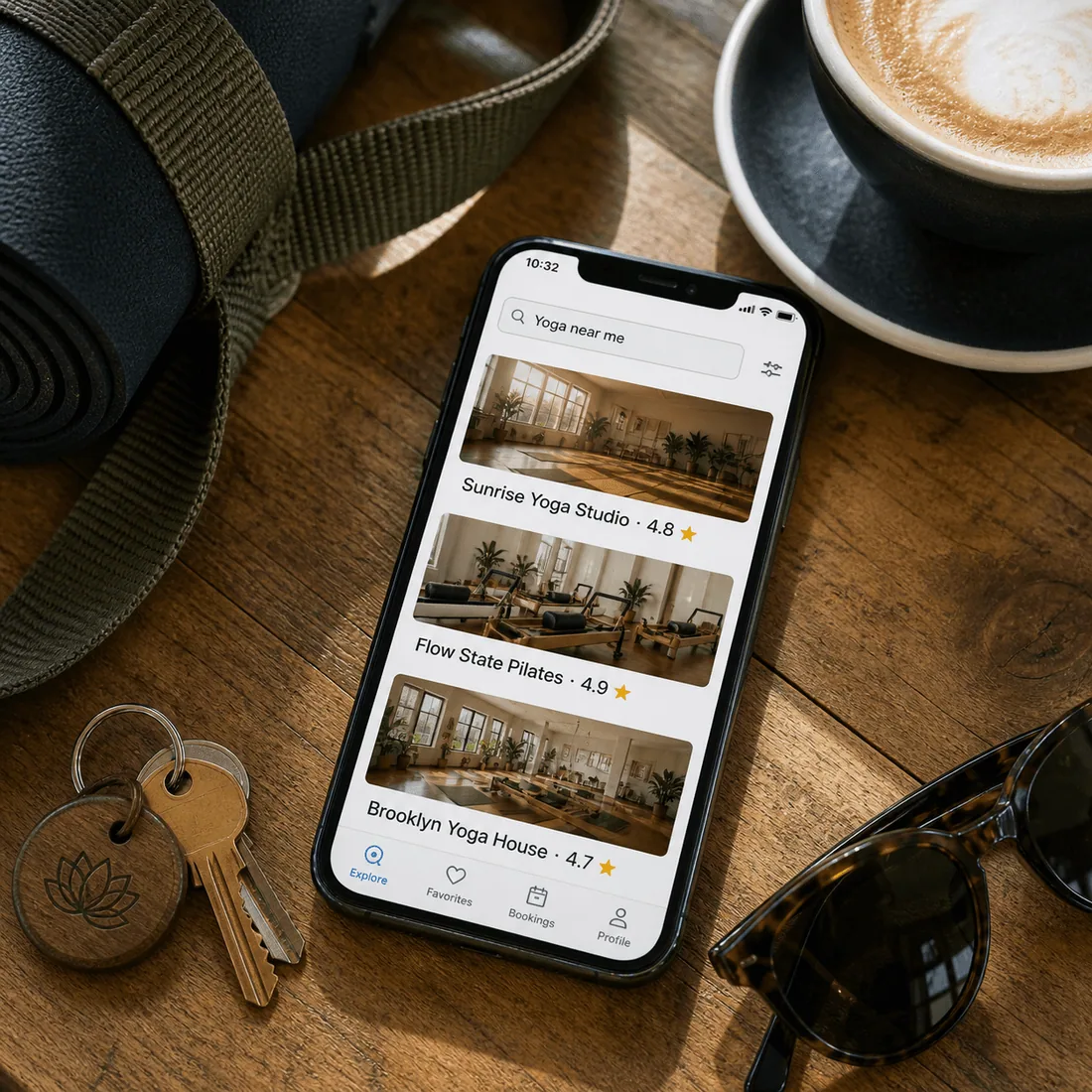
This is where most "Mindbody alternative" articles get dishonest. They skip the one thing that actually matters: the marketplace.
The Mindbody consumer app has over 3.5 million monthly active users searching for fitness experiences. Studios report that 10 to 30% of new members discover them through the Mindbody marketplace. For a studio in a dense urban market, that could mean 20 to 60 first-time bookings a month without any marketing spend.
Turn off Mindbody, and that traffic vanishes overnight. You need a plan to replace it.
Three realistic replacement paths:
Local SEO and Google Business Profile. Free, but takes 3 to 6 months to compound. Optimize your Google listing with class photos, accurate hours, and review generation. If you're already ranking for "[yoga/pilates] near [your neighborhood]", the transition is manageable. If you're invisible on Google Maps, start building 90 days before you cancel Mindbody.
ClassPass partnership. Lower commission than Mindbody's marketplace in most cities, similar discovery effect. Worth running parallel to your direct booking. Studios in competitive markets use ClassPass specifically as a trial funnel, then convert to direct membership.
Paid acquisition. Meta and Google Ads targeting "[class type] near me" intent. Predictable but not cheap. Most boutique studios pay $25 to $50 per first-class booking through paid channels.
The studios that leave Mindbody successfully have all three running before they cut over. The ones that struggle tell themselves "we'll figure out marketing later" and watch new-member acquisition drop 20% in month two.
The other real loss: scheduling depth. Mindbody handles multi-resource scheduling that assigns rooms, equipment, and instructors to each class. It supports waitlist management with automatic promotion, series and workshops with multi-session registration, and recurring class templates with exception handling. If you're running 30+ classes a week with reformer assignments, instructor swaps, and a real waitlist culture, no Shopify booking app fully replicates this yet. That's an honest gap.
What Shopify gives you that Mindbody doesn't
The flip side is real too. Mindbody is a closed ecosystem. Shopify is an open one. Here's what changes when your booking sits inside your commerce store.
Native retail for everything that isn't a class. Branded apparel, water bottles, mat bags, on-demand video courses, e-books, retreat packages, gift cards. All of this sits natively in Shopify with proper inventory, proper checkout, customer accounts. Mindbody handles retail awkwardly and digital products barely at all.
Full ownership of customer data. Every email address, every purchase, every booking behavior lives in your Shopify store and flows directly into Klaviyo, Mailchimp, or whatever marketing tool you use. With Mindbody, you're renting access to your own customer list. Try exporting everything when you leave. It's not fun.
Modern checkout. Apple Pay, Shop Pay, Google Pay, one-tap on mobile. Conversion rates on Shopify's checkout consistently beat third-party booking flows. For a studio doing 200 trial bookings a month, even a 5% conversion improvement is 10 extra members.
Lower card processing. Shopify Payments charges 2.9% + $0.30 online and 2.6% + $0.10 in-person. Mindbody charges 3.60% + $0.30 for online transactions and 2.99% + $0.30 in-studio. On $25,000 a month in revenue, that difference is roughly $1,350 a year in processing fees alone.
A real app ecosystem. Need automated review collection after class? There's a Shopify app. Need upsells at checkout? Shopify Flow handles that. Need email automation triggered by booking events? Klaviyo plus your booking app. The flexibility is genuinely broader than Mindbody's walled garden.
How to set up class booking on Shopify, step by step

Here's the actual workflow for a boutique studio offering 5 weekly yoga classes, 2 Pilates reformer classes, and 1:1 private sessions. This assumes Cowlendar as the booking layer.
1. Create one Shopify product per class type. "Vinyasa Flow" at $28, "Restorative Yoga" at $28, "Reformer Beginner" at $42, "60-min Private Session" at $85. Each product becomes a bookable service. Set the price as the drop-in rate.
2. Install Cowlendar and link each product. In the Cowlendar dashboard, go to My Services and link each Shopify product to a service. Cowlendar must be linked to a Shopify product to function, even for free services.
3. Set time slots and capacity per class. For "Vinyasa Flow", set Tuesday/Thursday 7am and Saturday 9am, capacity 18 per slot. For reformer classes, capacity 6 (one per machine). The "Booking limit per timeslot" setting controls how many people can book a given slot. The "count bookings by Timeslot" rule ensures the cap is enforced regardless of group size.
4. Configure buffer time between classes. If your reformer studio needs 15 minutes for cleanup, set buffer time per service in Cowlendar's settings. This blocks the gap automatically between back-to-back sessions.
5. Set up multi-instructor availability. Cowlendar's "Per Team Member" availability mode is ideal for businesses with 2 to 99 team members. It links each service to a specific team member and manages availability per provider. Each instructor gets their own calendar. Solo studios skip this step.
6. Connect Google Calendar sync. Two-way sync prevents double-booking when an instructor blocks personal time. This feature is available on Cowlendar's paid plans.
7. Add custom intake questions. You can add custom questions to the booking form: text fields, multiline, dropdowns, checkboxes. "Any injuries we should know about?" or "Is this your first reformer class?" helps your instructors prepare before the student walks in.
8. Set up class packs and memberships inside Cowlendar. Two options, both native. For a fixed pack (e.g., "4-Class Yoga Bundle"), create a Bundle service in Cowlendar (Pro plan): add the specific dates and times, set "Fixed number of slots", and the widget preselects all sessions automatically. For a monthly membership with flexible booking, use Cowlendar's Subscription feature (Ultra plan): set a billing interval (e.g., $189/month), assign booking credits per cycle (e.g., 12 credits = 12 classes), and optionally require a minimum commitment. Customers manage pause/cancel from their Shopify account. 1 credit = 1 booking, credits refresh each billing period. No external subscription app needed.
9. Build email automation in Klaviyo. Booking confirmation with parking instructions (immediate), 24-hour reminder with what-to-bring list, post-class review request (2 hours after class end), win-back if no booking in 14 days. Trigger off Shopify order events.
10. Run parallel for 30 days before cutting Mindbody. New signups book through Shopify. Existing class packs and memberships stay in Mindbody until they expire. Don't cold-cut.
This is more setup than Mindbody, which gives you the whole stack out of the box. But you're trading 4 to 8 hours of one-time configuration for $5,000+ in annual savings and full data ownership.
Best Shopify booking apps for yoga and fitness studios
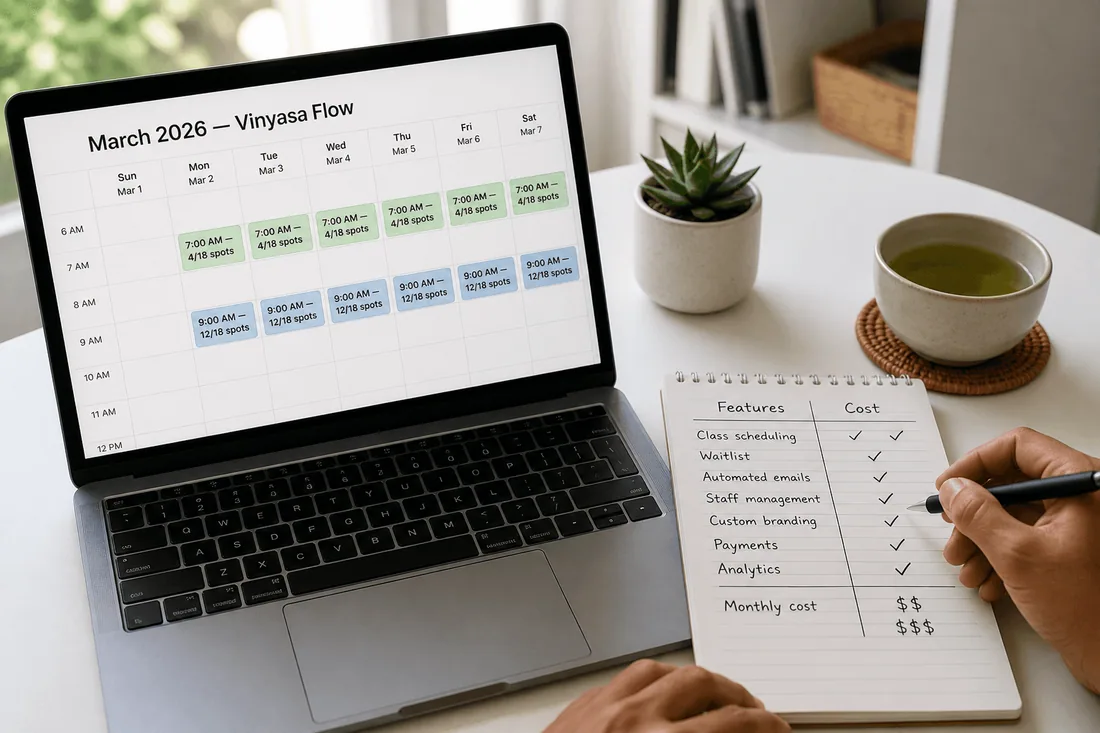
Pick the booking layer based on how complex your schedule actually is, not based on feature comparison tables.
1. Cowlendar: best for most boutique studios
Cowlendar's scheduling widget replaces the "Add to Cart" button with a "Book Now" popup directly on any product page, so customers never leave the page to schedule. Trusted by 22,500+ merchants with a 4.9-star rating across 2,000+ reviews.
Best for: Boutique studios with 1 to 5 instructors, a manageable weekly class schedule, and a brand identity worth protecting. If your member experience is "book Vinyasa, get reminder, show up, repeat", this is the cleanest fit.
Pros:
Free plan covers core booking, reminders, and unlimited services
Per-timeslot capacity caps and group booking work natively for class scheduling
Bundle service for fixed class packs with preselected dates and times
Subscription feature with recurring billing, booking credits per cycle, minimum commitment, and customer self-service pause/cancel
Buffer time between classes configurable per service
Three availability modes: Per Service (solo providers), Per Team Member (2 to 99 staff), and Per Equipment (rentals, reformers)
Google Calendar, Zoom, Google Meet integrations on paid plans
24/7 chat support with verified response times in App Store reviews
Limitations:
- No consumer marketplace for studio discovery
Pricing: Free plan available; Pro at $13.99/month; Elite at $25.99/month; Ultra at $39.99/month.
Shopify App Store: apps.shopify.com/cowlendar
2. Sesami: best for multi-location and POS-heavy studios
Sesami integrates with both Shopify's online store and Shopify POS, letting customers book in-store or online from the same system. Rated 4.9/5 with 453+ reviews.
Best for: Studios with 2+ locations where front-desk staff regularly book walk-ins through the POS terminal. The omnichannel angle is genuine and well-executed.
Pros:
Native Shopify POS integration, not bolted on
Sesami Flows for automated email workflows and webhook triggers
Klaviyo integration on Pro tier
Customer rescheduling and cancellation flows on higher tiers
Limitations:
The price jump from the Small plan ($19) to Pro ($129) is steep if you need Klaviyo or advanced reporting
Less organic community presence than Cowlendar (worth checking their blog and social activity before committing)
Pricing: Free plan available; Small at $19/month; Pro at $129/month; Premium at $299/month for Shopify Plus merchants.
Shopify App Store: apps.shopify.com/sesami
3. Easy Appointment Booking: best for multilingual studios and booking packs
Easy Appointment Booking supports booking packs, intake forms, and multilingual flows. One merchant specifically highlighted it as "the only app we found that handled pre-paid packages of bookings properly."
Best for: Studios that sell 5-class or 10-class packs as a core business model, or studios serving multilingual communities (Spanish in Texas, French-Canadian in Quebec).
Pros:
Native booking pack / class pass support (a feature most competitors lack)
Multilingual booking interface out of the box
Google Calendar, Zoom, and Klaviyo integration
Team portal for staff to manage their own bookings
Limitations:
The free plan is functional but limited in automations
Less name recognition than Cowlendar or Sesami in the Shopify ecosystem
Pricing: Free plan; Standard at $15/month; Pro at $29/month; Pro Plus at $39/month.
Shopify App Store: apps.shopify.com/appointments-and-bookings
4. BookThatApp: best for class-series and multi-week programs
BookThatApp is one of the oldest booking apps on Shopify with deep logic for series-based businesses.
Best for: Studios that run multi-week programs (an 8-week beginner Pilates progression, a 6-week prenatal yoga course) where a single registration covers multiple sessions.
Pros:
Mature class-series support with multi-session registration
Strong API for custom integrations
Inventory-aware booking (useful for equipment alongside classes)
Limitations:
Per-booking pricing tiers: Lite at $25/month (50 bookings), Premium at $49.95/month (350 bookings), Business at $110/month (1,000 bookings). Costs scale with volume.
UI feels dated compared to newer apps
Social and content channels have been quiet. Verify support responsiveness before committing.
Pricing: Free up to 10 bookings/month; paid from $25 to $110/month.
Shopify App Store: apps.shopify.com/bookthatapp
Comparison table
Feature | Cowlendar | Sesami | Easy Appt Booking | BookThatApp |
|---|---|---|---|---|
Free plan | ✅ | ✅ | ✅ | ✅ (10 bookings/mo) |
Entry paid tier | $13.99/mo | $19/mo | $15/mo | $25/mo |
Class capacity caps | ✅ | ✅ | ✅ | ✅ |
Per-class buffer time | ✅ | ✅ | ✅ | 🟡 |
Multi-instructor calendars | ✅ | ✅ | ✅ | ✅ |
Equipment-based availability | ✅ | 🟡 | ❌ | ✅ |
Shopify POS native | ✅ | ✅ | ✅ | 🟡 |
Google Calendar 2-way sync | ✅ | ✅ | ✅ | ✅ |
Klaviyo integration | ✅ | ✅ (Pro tier) | ✅ | ✅ |
Native class-pack / punch card | ✅ | 🟡 | ✅ | ✅ |
Custom intake questions | ✅ | ✅ | ✅ | 🟡 |
Consumer marketplace | ❌ | ❌ | ❌ | ❌ |
The marketplace row is the honest one. No Shopify booking app gives you a Mindbody-style consumer marketplace. That's the core tradeoff: Shopify wins on cost, data ownership, and commerce flexibility. Mindbody wins on built-in discovery in dense markets.
FAQ: Mindbody vs Shopify for fitness studios
Can I sell class packs and memberships on Shopify the way I do on Mindbody?
Yes. Cowlendar handles both natively. For fixed class packs (e.g., "4-Class Yoga Bundle" with predetermined dates), use the Bundle service type available on the Pro plan. The booking widget preselects all sessions automatically. For monthly memberships with flexible booking, use Cowlendar's Subscription feature on the Ultra plan: set a billing interval, assign booking credits per cycle (1 credit = 1 booking), and optionally enforce a minimum commitment. Customers can pause or cancel from their Shopify account. Here's the full setup guide for subscriptions.
Will my students need to download a new app to book?
No. Bookings happen directly on your Shopify website. Students visit your site, pick a class, and book. No separate app needed. You can add a "Book a Class" link to your Instagram bio, email signature, or Google Business Profile that goes straight to the product page.
How do I handle existing class packs when migrating?
Don't cold-cut. Let existing packs expire naturally through Mindbody while routing new purchases through Shopify. For VIP members with large remaining balances, manually create their credits in the new system and send a personal email explaining the transition. Most studios run both systems in parallel for 30 to 60 days.
Does Shopify support waitlists for full classes?
Shopify doesn't have a native waitlist. Some booking apps offer waitlist-adjacent functionality, but it's not as mature as Mindbody's automatic waitlist promotion. If waitlist management is critical to your studio culture (where 20% of your Tuesday 6am class books off the waitlist weekly), this is a genuine gap to consider.
What about reporting? Mindbody has attendance tracking, revenue by class, instructor performance.
Shopify's native analytics cover revenue, conversion, and customer behavior. For class-specific attendance tracking, you'll rely on your booking app's reporting (Cowlendar and Sesami both offer appointment reporting) plus Klaviyo for engagement metrics. It's less centralized than Mindbody but the data is richer for marketing because it includes purchase behavior alongside booking data.
Can I still use ClassPass if I move to Shopify?
Yes. ClassPass operates independently of your booking system. You can list your studio on ClassPass and handle those bookings separately while running your direct bookings through Shopify. Many studios use ClassPass specifically as a trial funnel, then convert to direct membership.
Conclusion
The migration math from Mindbody to Shopify works in your favor by $5,000 to $10,000 a year for most single-location boutique studios. But the marketplace traffic is real, and pretending otherwise is how studios lose their new-client pipeline in month one. The honest answer: make this move if you already run a Shopify store, your schedule isn't operationally extreme, and you have a concrete plan (local SEO, ClassPass, paid ads) to replace marketplace discovery before you flip the switch.
If you decide to move and your studio runs on a manageable class schedule with 1 to 5 instructors, Cowlendar handles class booking, capacity caps, buffer time, team member calendars, class bundles (Pro plan), and recurring subscriptions with booking credits (Ultra plan) natively on Shopify. Try it: apps.shopify.com/cowlendar
Originally published on the Cowlendar blog. This article keeps its original publication history; the page layout has been refreshed.
Originally published May 5, 2026.




 Built for Shopify


