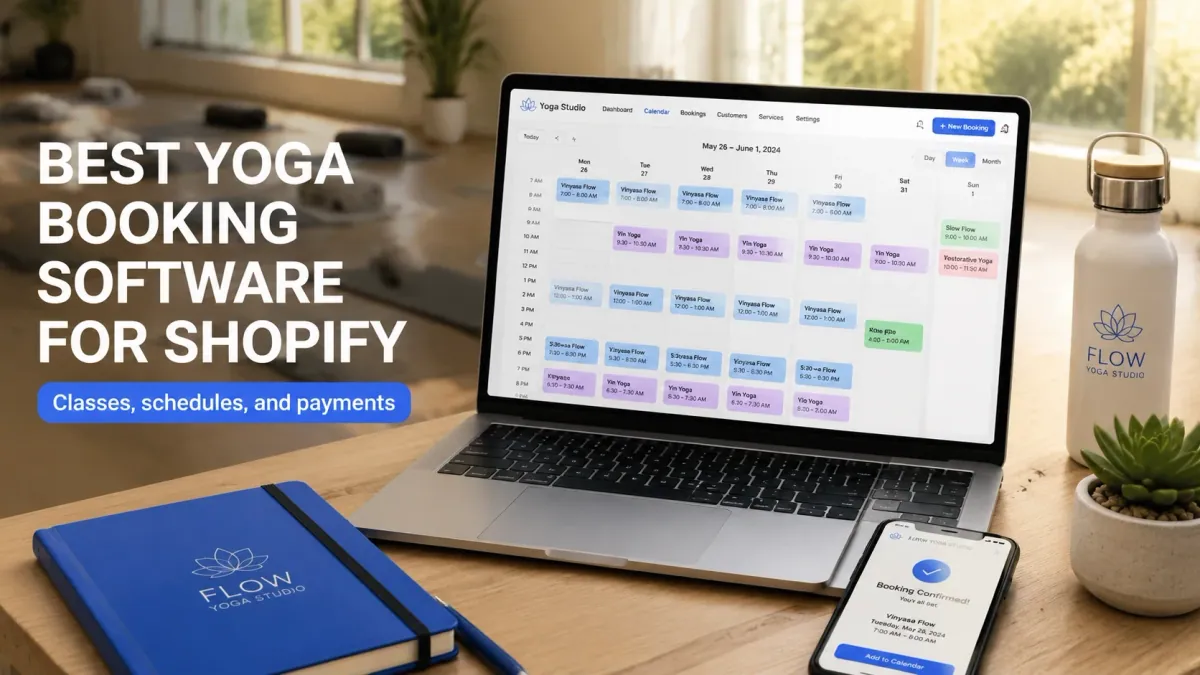
A yoga studio running 20 classes a week across two instructors doesn't need a $200/month enterprise platform to manage bookings. What it needs is a system that handles group class capacity, collects payment at the time of booking, sends a reminder the night before, and doesn't force students to download a separate app just to reserve a mat. Shopify, paired with the right booking app, solves every one of those problems at a fraction of what dedicated yoga studio software costs. This is a practical breakdown of what actually works, which apps to consider, and how to set up the most important pieces without spending a full afternoon in admin.
Why yoga studios are moving to Shopify in 2026
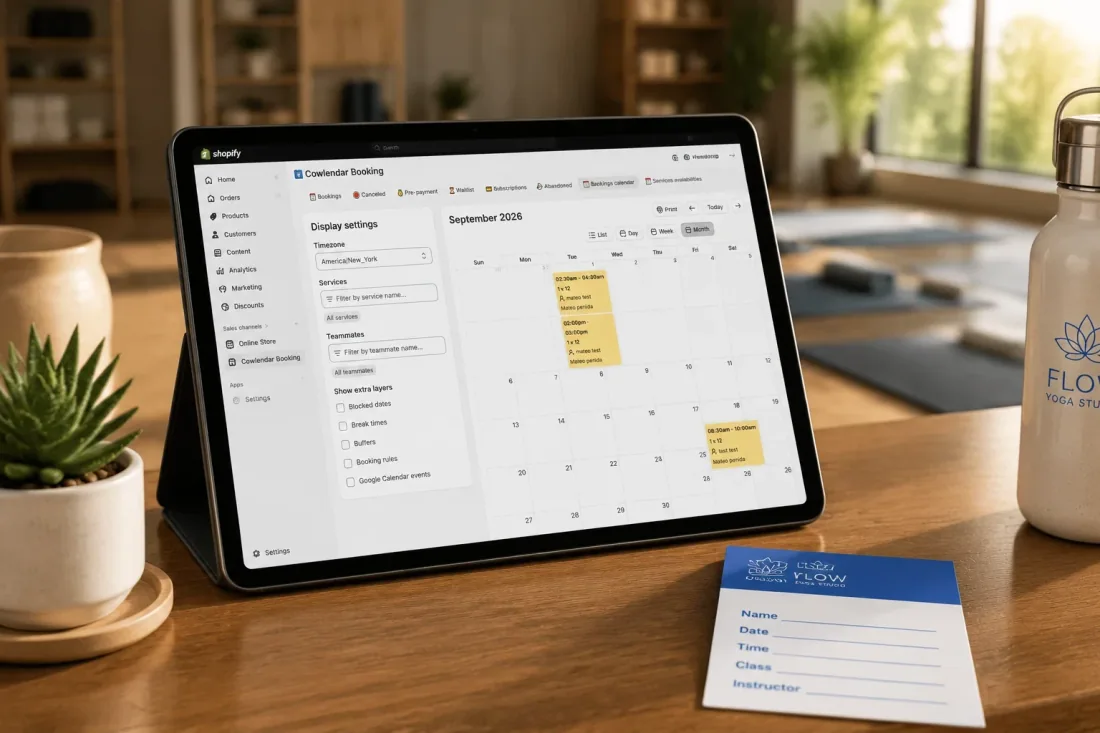
The yoga studio industry in the US alone generates $9.3 billion annually, with memberships and class packs driving 55% to 65% of revenue for well-run studios. The problem with most dedicated yoga software is that the cost structure scales against you: Mindbody starts at $99/month per location with additional transaction fees and a commission on bookings made through its own marketplace, and WellnessLiving starts at $69/month on annual billing. For an independent studio running 15 classes a week with one to three instructors, those fees can represent 5% or more of total revenue before a single mat is unrolled.
Shopify doesn't replace Mindbody's marketplace discovery feature (which lets millions of Mindbody app users find your studio) or its deep reporting suite. But for a studio that generates its bookings through its own marketing, social media, or local reputation, paying for infrastructure built to support multi-location chains makes no sense. The math often favors Shopify once you factor in what you actually need versus what you're paying for.
For the full migration cost comparison, Cowlendar's breakdown of Mindbody vs Shopify for yoga and fitness studios goes through the per-transaction numbers in detail.
What yoga studios actually need from booking software
Most yoga-specific booking requirements come down to four things, and it's worth mapping your actual situation before picking an app.
Group class capacity with per-class limits
A Vinyasa flow class that holds 18 students needs the booking system to count attendees correctly and close the slot once it's full. This sounds basic, but several apps handle this badly either by allowing overbooking or by not reopening the slot correctly when someone cancels. You need to verify, not assume.
Class packs and recurring memberships
A significant portion of studio revenue comes from selling class packs (5, 10, or 20 classes) or monthly unlimited memberships, not just individual drop-in bookings. The booking software and the payment system have to handle this together, since a student who pre-bought a 10-class pack needs to be able to redeem classes without paying again at checkout.
Deposits and upfront payment to reduce no-shows
Monthly studio churn runs at 5% to 10%, and no-shows on any given class can exceed 20% without a deposit or paid booking requirement. Requiring payment (or a minimum deposit) at booking time significantly reduces this. Not all booking apps on Shopify support deposit-taking at the level that yoga studios actually need.
Instructor assignment and multi-instructor scheduling
If your studio has three instructors, you need the booking system to assign each class to the right person, let students see who's teaching, and block the instructor's personal calendar when they're unavailable. Per-team-member availability is a feature, not a given.
How to set up yoga class bookings on Shopify with Cowlendar
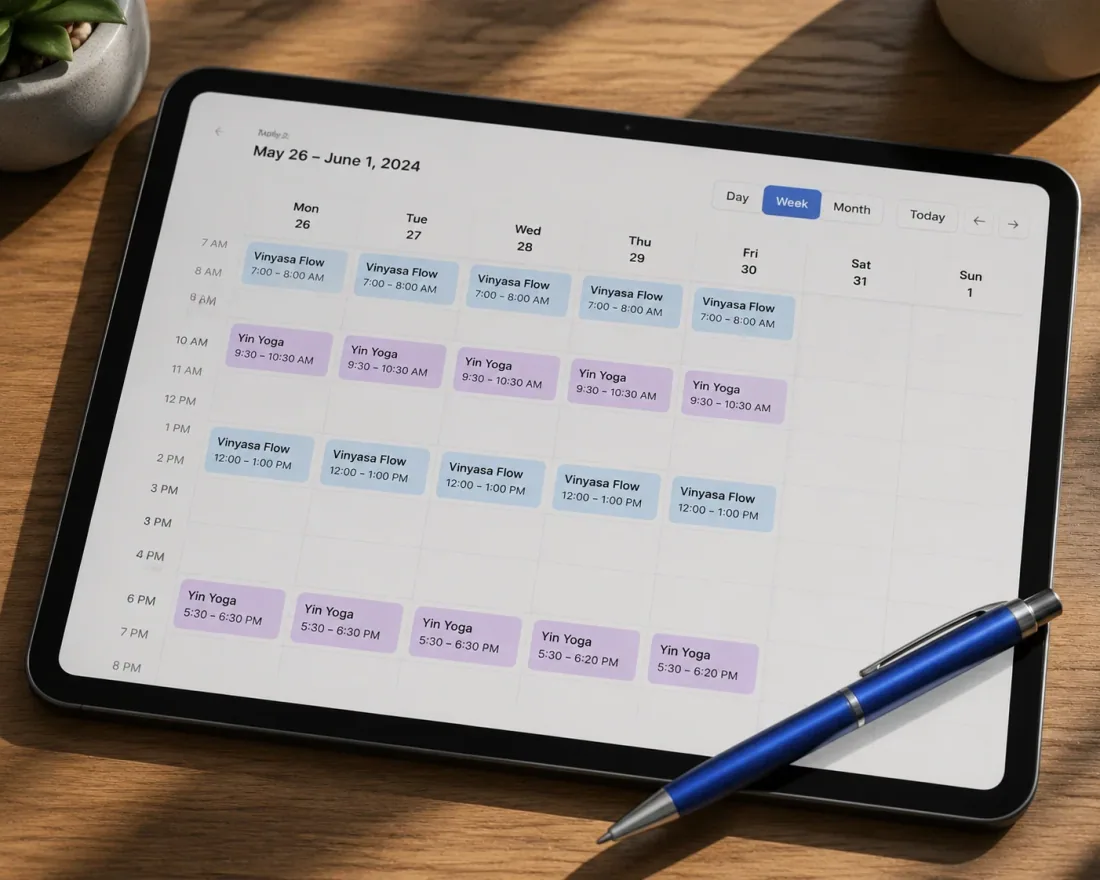
This walkthrough assumes you've installed Cowlendar from the Shopify App Store and connected it to a Shopify product. The setup pattern works regardless of whether your service is a drop-in class, a 10-class pack, or a private session.
Step 1: Create one Shopify product per class type
Create a product in Shopify for each distinct class format: "Vinyasa Flow (75 min)" and "Yin Yoga (60 min)" are separate products because they have different durations and potentially different instructors. Link each product to a Cowlendar service after creating it. This is how Cowlendar converts the standard "Add to Cart" button into a "Book Now" button.
Step 2: Set class capacity per timeslot
In Cowlendar's service settings, use the group booking configuration to set how many students can book each timeslot. For a class that holds 18 students, set the limit to 18. Once 18 bookings come in for a given slot, that slot disappears from the calendar for new students. This is the Quantity on Service setting in Cowlendar, and it operates differently from booking limits per team member, so verify you're using the right one for your setup.
Step 3: Assign instructors per class
In Cowlendar, switch the availability mode from "Per Service" to "Per Team Member" mode. This means each instructor manages their own availability calendar, and the student sees which instructor is running each timeslot. For a studio where students have a preferred teacher, this matters for retention. Students who consistently book with one instructor show higher rebooking rates than those booking blindly into a class slot with no instructor visible.
Step 4: Set up deposits or full upfront payment
For drop-in classes where a no-show costs you a real slot, require full payment at booking. Cowlendar handles this through Shopify's standard checkout, which means the student pays before their booking is confirmed. For larger packages like a 10-class pack, you can configure the product as a bundle service (available on Cowlendar's Pro plan and above), letting students purchase multiple sessions at once and book them over time.
Step 5: Turn on email reminders
A reminder sent 24 hours before class, with the studio address or Zoom link, is the single most impactful thing you can do to reduce no-shows. Cowlendar sends automated reminders on paid plans. The Cowlendar and Klaviyo email flows guide goes deeper if you want to build more sophisticated pre- and post-class email sequences beyond what the booking app handles natively.
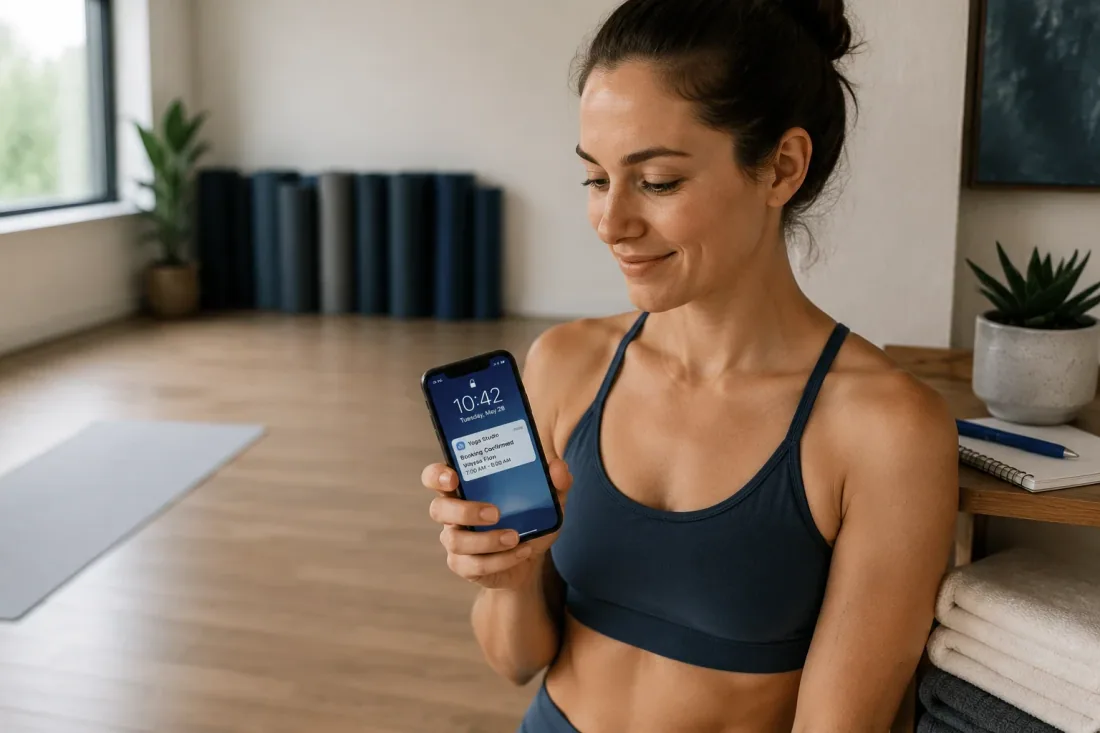
[EDITOR NOTE, DELETE BEFORE PUBLISHING: insert Stock Image 2 here. Yoga instructor checking a phone showing a booking confirmation notification, standing in a bright studio space with mats visible in the background, blue accent prop on the reception counter.]
Step 6: Test the full student experience before going live
Book a test class yourself from a private browser as if you're a student. Confirm the confirmation email arrives, check the studio address or Zoom link is correct, and verify the class drops in capacity by one. Catch edge cases in the test, not from a confused student on Monday morning.
For a broader walkthrough of the setup steps that apply across different booking apps, Cowlendar's guide to offering group bookings on Shopify covers capacity logic and waitlist strategies in more depth, including what to do when your most popular Tuesday evening slot consistently fills in under 10 minutes.
Best Shopify booking apps for yoga studios in 2026
Cowlendar is the most-reviewed booking app on the Shopify App Store (over 2,050 reviews, 4.9 stars), and it covers the core yoga studio requirements: group class capacity, instructor assignment, deposits, bundle services for class packs, and subscription bookings with credits for unlimited membership models. The free plan handles unlimited bookings and includes Google Calendar sync, which matters if you're running a solo instructor studio and want your personal calendar updated automatically. Paid plans start at $13.99/month. The one limitation worth naming honestly is that Cowlendar doesn't have a native consumer marketplace, so students find you through your own Shopify store or marketing, not through a Cowlendar discovery app. If new client discovery through a booking platform's own audience is important to your business model, that's a real gap relative to Mindbody.
Meety stands out for yoga studios that have full classes regularly and want an automated waitlist. When a timeslot fills up, Meety can automatically notify the next person on the waitlist when a cancellation opens a spot, without you doing anything manually. For a hot yoga studio running classes that fill in advance, this converts cancellations into refilled slots instead of lost revenue. It also supports subscriptions and bundle bookings natively. Paid plans range from $14 to $47/month. Where Meety is slightly weaker than Cowlendar is in overall install base and review volume (fewer verified use cases across edge cases), though its reviews consistently highlight strong feature depth for class-based businesses.
Sesami is the right pick if your studio also has a physical retail component (mats, props, branded apparel) and you want bookings and in-store sales to run from a single dashboard through Shopify POS. Its omnichannel setup handles both the front desk check-in for walk-in class attendees and online advance booking in one place. If you run in-store retail alongside your class schedule, Sesami's POS integration is more complete than what Cowlendar or Meety offer at comparable tiers. Its Small plan starts at $19/month, though the feature set most yoga studios actually need sits closer to the Pro tier at $129/month, a meaningful price jump.
Easy Appointment Booking is the strongest native option for studios that sell pre-paid class packs (5 sessions, 10 sessions, punch-card style) as a primary revenue model. Its class pack redemption system is more purpose-built for this specific pattern than Cowlendar's bundle feature. If class packs are your main selling model and you have merchants specifically asking for this, it's worth installing the free plan to test the pack redemption flow against what Cowlendar's bundle feature produces. 5.0 stars across 450+ reviews.
Tips for success once you're live
Keep your class schedule on Shopify consistent with what's on your physical studio schedule. The single most common support ticket for studio booking setups is a student who sees a timeslot online that's been cancelled in the real world but not in the app. Sync your changes immediately, not at the end of the day.
Write your cancellation and refund policy before your first drop-in class sells out, not after someone wants a refund for a class they booked and missed. A simple line on the product page ("Classes are non-refundable; rescheduling available up to 12 hours before class time") eliminates most disputes before they start.
Sell an intro class pack as your first conversion offer. A studio running a "first 2 weeks unlimited for $30" intro offer as a Shopify product with a bundle booking service configuration converts new students into recurring members better than a single drop-in sale, because it gets someone on the mat multiple times in the first two weeks instead of once. The research on fitness studio retention consistently shows that members who attend at least 3 sessions in their first two weeks have dramatically higher long-term retention.
Set capacity below your physical maximum by 1 to 2 spots. A 20-mat studio with a booking cap of 18 gives you room for walk-ins, late arrivals, or a student who booked but didn't check in correctly. This buffer also prevents the situation where you're technically "full" online but have two mats visibly empty in class, which reads badly to walk-ins.
FAQ
What's the best booking app for a yoga studio on Shopify?
Cowlendar covers the most ground for most yoga studios: group class capacity, instructor assignment, deposits, class pack bundles, subscription bookings, and Google Calendar sync, all within a price range that makes sense for an independent studio. If automated waitlists are a priority, Meety adds that natively. If class packs are your primary model, Easy Appointment Booking's pack redemption system is worth testing before committing. There's no single best answer, but Cowlendar's install base of 22,500+ merchants and 2,050+ reviews means more documented edge cases have been resolved than with newer entrants.
Can Shopify replace Mindbody for a yoga studio?
For studios that generate their own traffic and bookings through their website, social media, or word of mouth, Shopify handles everything Mindbody does at a fraction of the cost. The one thing Shopify doesn't replace is Mindbody's consumer discovery marketplace, where millions of Mindbody app users search for nearby classes. If you rely on that marketplace for new student acquisition, Shopify alone won't cover that gap. For the full cost comparison, the Mindbody vs Shopify migration math article breaks this down in detail.
How do I sell class packs or memberships on Shopify?
Class packs work through Cowlendar's bundle service feature (Pro plan), where a student buys a block of sessions at once and redeems them individually over time. Unlimited monthly memberships work through Cowlendar's subscription feature (Ultra plan), where a student pays monthly and receives a set number of booking credits per cycle. Both require a paid Cowlendar plan; the free tier supports individual bookings only. Easy Appointment Booking is an alternative specifically built around class pack redemption if your entire model revolves around pre-paid packs.
Do Shopify booking apps support waitlists for yoga classes?
Not all of them do. Meety has the most mature native waitlist implementation among the major Shopify booking apps, automatically notifying the next student on the waitlist when a cancellation frees up a spot. Cowlendar currently handles waitlists differently, letting you manually promote waitlisted students to confirmed spots rather than automating the promotion. For a studio where popular classes fill regularly and manual waitlist management is a real time sink, this is a genuine difference worth checking before choosing an app.
Can students book recurring weekly yoga classes without rebooking each week?
Yes, with Cowlendar's subscription booking feature on the Ultra plan, a student can book a recurring timeslot (for example, every Tuesday at 7pm) and have it automatically held each week as long as their subscription is active. This works best for private sessions or small-group recurring classes rather than large open-enrollment drop-in classes where different students attend each week. For individual class bookings that aren't recurring, students book each session separately.
Conclusion
Shopify handles yoga studio booking well when you pair it with the right app. Group classes, class packs, instructor assignment, and upfront payment are all solvable within the Shopify ecosystem at a monthly cost that makes sense for an independent studio. Cowlendar covers the most common studio requirements from the Pro plan up, with Meety as the stronger option if automated waitlists matter to your operation, and Easy Appointment Booking if class pack redemption is your primary model. Start on the free plan to verify the student booking experience works the way you expect, then upgrade once the flow is confirmed. Install Cowlendar from the Shopify App Store and test your first class before your next teaching session.
Originally published on the Cowlendar blog. This article keeps its original publication history; the page layout has been refreshed.
Originally published Jun 21, 2026.




 Built for Shopify


