A yoga instructor in Austin, TX teaches 18 classes per week across 3 studios.
She uses Google Calendar to manage her personal schedule (doctor appointments, family events, personal commitments) and a Shopify booking app for her class schedule. Last Tuesday, she blocked off 2 to 4 PM in Google Calendar for a dentist appointment but forgot to update her booking page.
A client booked a private session at 3 PM through her Shopify store.
When the client showed up, the instructor was at the dentist.
She lost the $120 session fee and the client's trust.
This scenario happens 2 to 3 times per month to service providers who manage two separate calendars.
The fix is simple: two-way Google Calendar sync that keeps your booking page and personal calendar aligned automatically.
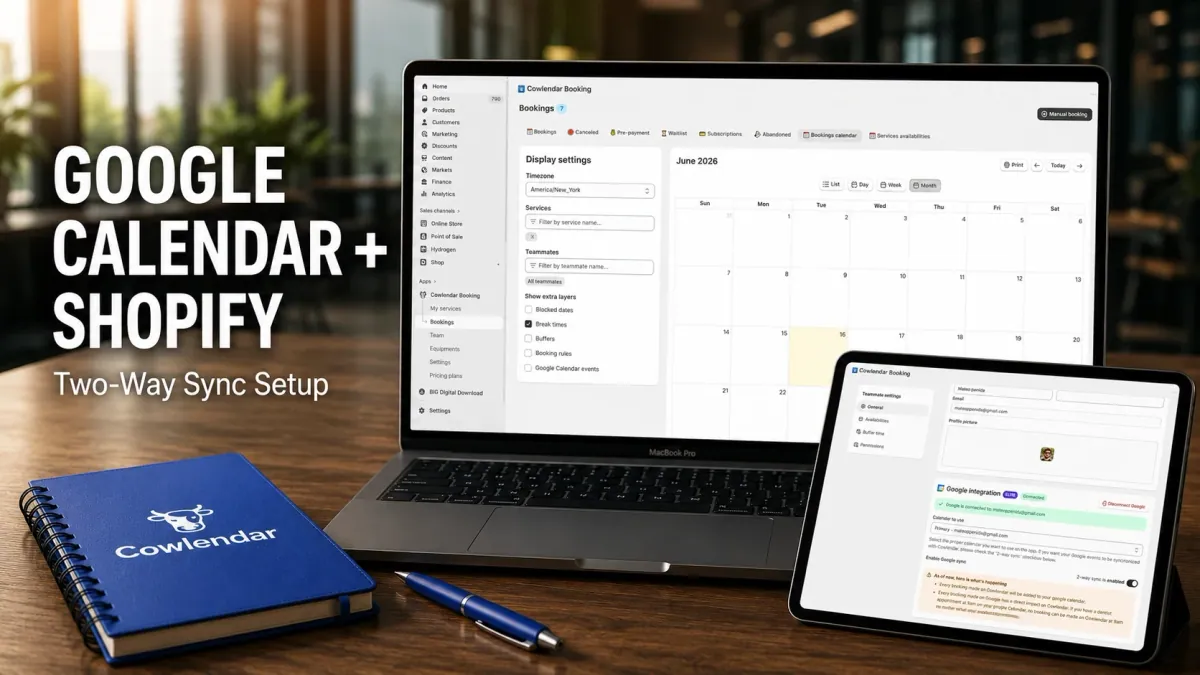
Here is how to set that up.Two-way Google Calendar sync means changes you make in Google Calendar (blocking off time, adding appointments, marking vacations) automatically update your Shopify booking page, and bookings made through your Shopify store automatically appear in Google Calendar.
This eliminates the gap between your personal schedule and your professional booking system.
Here is exactly how to set it up, which apps support it, and the common mistakes that cause sync failures.
Why One-Way Sync Is Not Enough
The problem with one-way sync
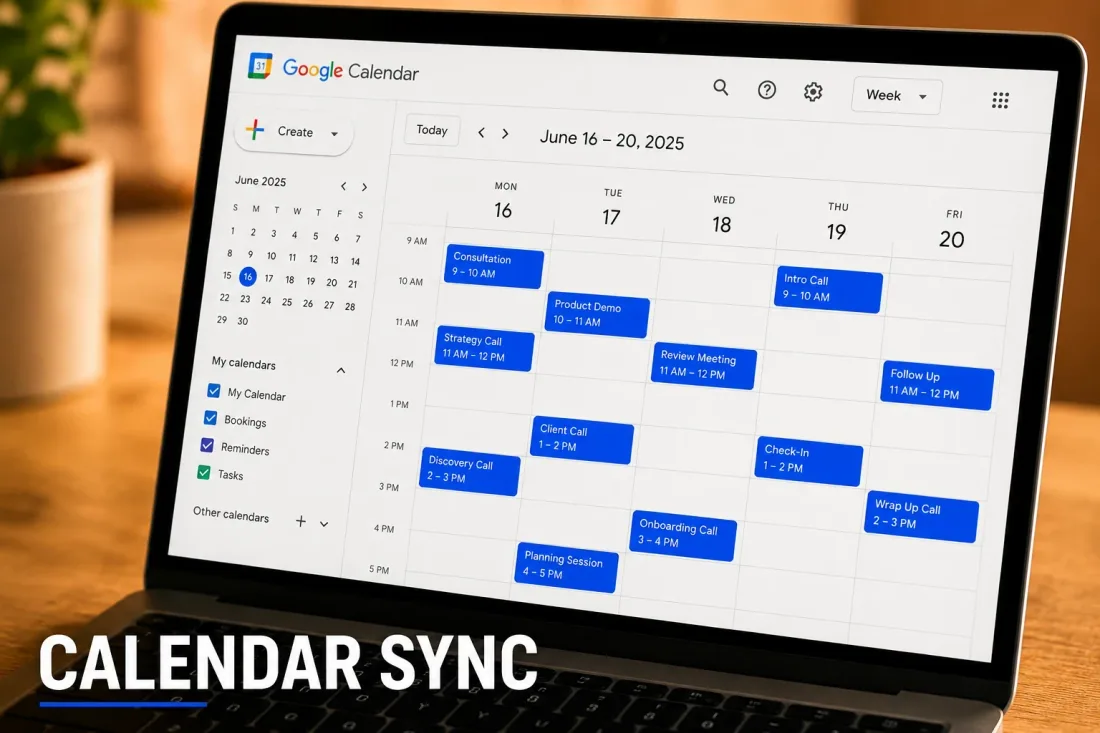
One-way sync pushes your Shopify bookings to Google Calendar. If a client books a 2 PM session through your store, that event appears in your Google Calendar. But the reverse does not happen. If you block off a Tuesday afternoon in Google Calendar for a personal appointment, your booking page still shows that time as available. A client can book that slot, creating a double-booking. One-way sync solves half the problem: you can see your bookings on your phone. But it does not prevent the most common cause of double-bookings: personal calendar entries that your booking page does not know about.
The cost of double-bookings
A double-booking does not just waste one appointment slot. It damages your professional reputation. A 2024 BrightLocal survey found that 87% of consumers read online reviews for local businesses. A single review mentioning a scheduling error can deter dozens of potential clients. A dental clinic in Phoenix, AZ experienced a double-booking when two patients were scheduled for the same 2 PM slot. One patient left a 2-star review that was viewed 340 times in 3 months, resulting in an estimated 5 to 8 lost new patient inquiries. The cost of one double-booking extends far beyond the single lost appointment. For more on preventing double-bookings, see our guide on how to prevent double bookings on Shopify even with a booking app installed.
Two-way sync solves both directions
Two-way sync means your Shopify bookings push to Google Calendar AND changes you make in Google Calendar pull back into your booking page. When you block off a Friday afternoon in Google Calendar, that time disappears from your booking page within minutes. When a client books a session through your store, the event appears in your Google Calendar with the client's name, service type, and booking details. Both calendars stay aligned without manual intervention. A coaching practice in Charlotte, NC that switched from one-way to two-way sync eliminated the 2 to 3 double-bookings they experienced per month.
How to Set Up Google Calendar Two-Way Sync
Step 1: Verify your booking app supports two-way sync
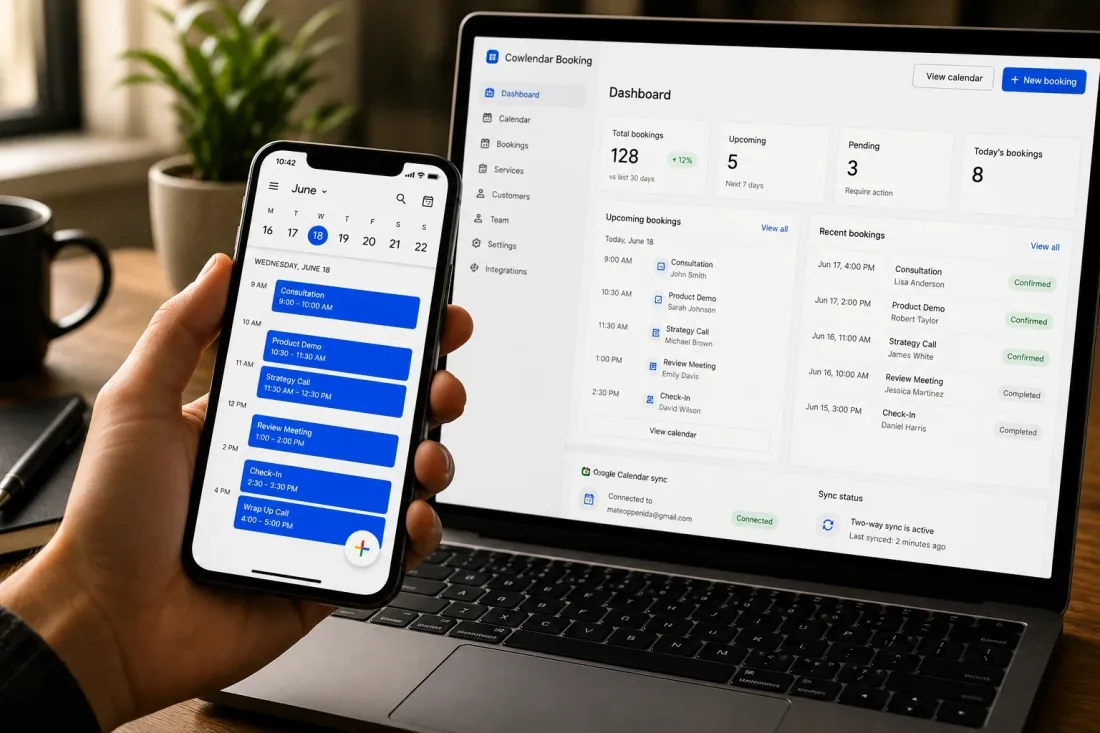
Not all booking apps support two-way sync. Some only push bookings to Google Calendar (one-way). Before setting up sync, confirm that your app supports two-way synchronization. Cowlendar supports Google Calendar two-way sync on all plans, including the free tier. Sesami supports two-way sync on paid tiers. BookThatApp supports two-way sync. Meety and Square Appointments do not support two-way sync on their free tiers. If your current app only offers one-way sync, switching to an app with two-way sync is the most impactful change you can make for scheduling accuracy.
Step 2: Connect your Google Calendar account
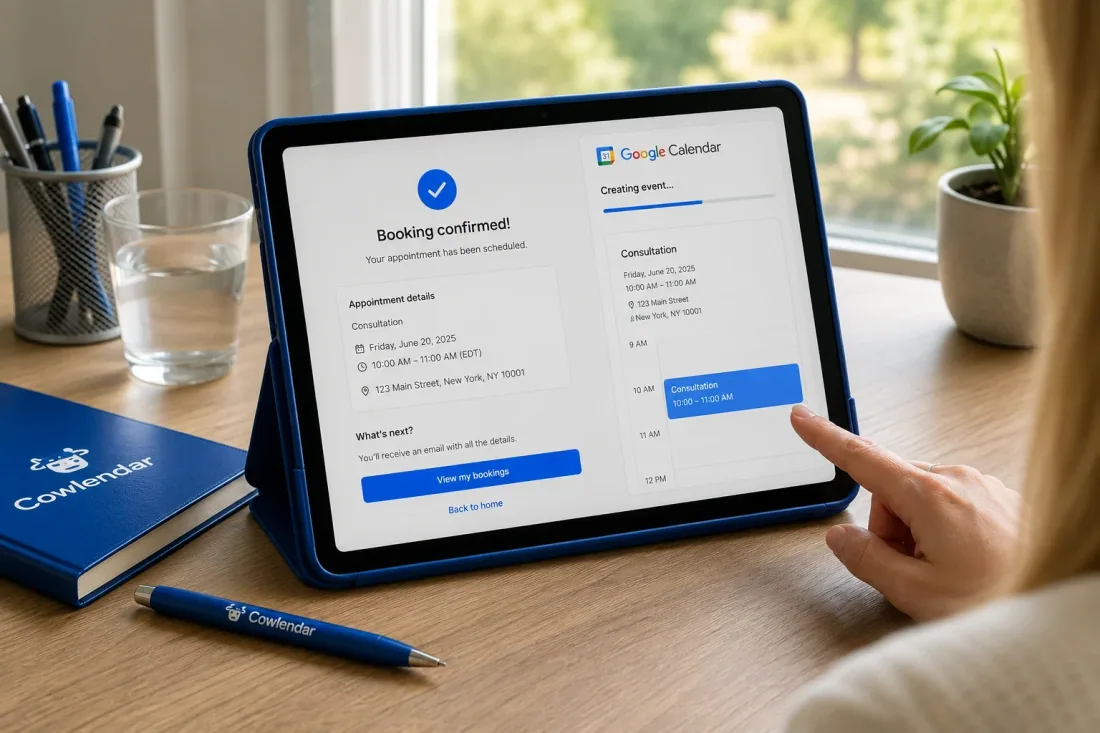
In Cowlendar's settings, navigate to the calendar sync section and connect your Google account. You will be prompted to authorize Cowlendar to access your Google Calendar. This authorization allows Cowlendar to both read and write events to your calendar. The connection uses Google's OAuth 2.0 protocol, which means Cowlendar does not store your Google password. A freelance photographer in Denver, CO connected her Google Calendar in under 2 minutes. Once connected, all existing and future bookings automatically sync to her Google Calendar.
Step 3: Configure sync settings
Choose which calendars to sync and how events should appear. Cowlendar lets you select which Google Calendar to use for sync (useful if you have separate calendars for personal and professional events). You can also configure how booking events appear in Google Calendar: as the client's name and service type, as the service type only, or as a custom format. A salon in Nashville, TN configured their sync to show "Haircut: Sarah M." in Google Calendar, which gives the stylist a quick reference for who is booked without opening the booking dashboard.
Step 4: Test the sync in both directions
After connecting, test both directions of the sync. First, book a test appointment through your Shopify store and verify it appears in Google Calendar within 5 minutes. Second, block off a 2-hour slot in Google Calendar and verify that the corresponding time disappears from your booking page within 5 minutes. If either direction fails, check your sync settings and reauthorize the connection. A financial planner in Chicago, IL tested his sync by booking 3 test appointments and blocking off 2 personal slots. All 5 changes synced within 3 minutes in both directions.
Step 5: Set up separate calendars for personal and professional events (optional)
If you want to keep personal and professional events separate, create two Google Calendar calendars: "Personal" and "Professional." Connect only the "Professional" calendar to your booking app. This way, personal events on the "Personal" calendar do not affect your booking page, while professional events on the "Professional" calendar do. A yoga instructor in Minneapolis, MN uses this two-calendar approach: her personal calendar (doctor appointments, family events) stays private, while her professional calendar (studio classes, private sessions) syncs with her booking page. This gives her control over which events affect her availability.
Common Sync Problems and How to Fix Them
Sync delay
After you make a change in Google Calendar, it should appear on your booking page within 5 minutes. If the delay exceeds 10 minutes, the sync may need to be reauthorized. Disconnect and reconnect your Google Calendar in Cowlendar's settings. A massage therapist in Portland, OR experienced a 30-minute sync delay and resolved it by reauthorizing the connection. The issue was caused by an expired Google authorization token, which happens occasionally with Google's OAuth system.
Events not appearing in Google Calendar
If bookings made through your Shopify store do not appear in Google Calendar, check that the sync is enabled and that the correct Google Calendar is selected. Cowlendar syncs to a specific Google Calendar, not all of your calendars. If you recently created a new Google Calendar, you may need to select it in Cowlendar's settings. A barbershop in Detroit, MI that created a new "Work" calendar in Google Calendar forgot to update Cowlendar's settings to point to the new calendar. The fix took 2 minutes.
Double-bookings still occurring
If you are still experiencing double-bookings after enabling two-way sync, the issue is likely that you have not blocked off the time correctly in Google Calendar. Two-way sync only blocks time that you have explicitly marked as busy in Google Calendar. If you add an event but leave it as "free" instead of "busy," the sync will not block that time on your booking page. A common mistake is adding a personal appointment as an "all-day event" without marking it as busy. Always set personal appointments as "busy" to ensure the sync blocks that time. A personal trainer in Seattle, WA that corrected this setting eliminated the last of his double-bookings.
Time zone mismatches
If your clients are in different time zones than you, the sync must handle time zone conversions correctly. Google Calendar handles time zones automatically, but your booking app must also support time zone detection. Cowlendar detects the client's time zone based on their browser settings and displays available time slots in their local time. When the booking syncs to Google Calendar, the event appears in your local time. A business coach in New York City who works with clients across 4 time zones confirmed that Cowlendar's time zone handling prevented 6 potential time zone confusion incidents in the first month.
Best Apps for Google Calendar Sync on Shopify
Cowlendar
Cowlendar offers two-way Google Calendar sync on all plans, including the free tier. The sync is bidirectional: bookings push to Google Calendar, and Google Calendar changes pull back into the booking page. Cowlendar also generates Zoom and Google Meet links that appear in the Google Calendar event, giving you a single view of all appointment details. A dental clinic in Scottsdale, AZ with 4 providers uses Cowlendar's two-way sync to keep all 4 Google Calendars aligned with the booking page. Zero double-bookings in 8 months since enabling sync. For more on clinic scheduling, see our guide on how to manage clinic appointments on Shopify.
Sesami
Sesami supports Google Calendar sync on paid tiers (Small at $19/month and above). The sync works in both directions, pushing bookings to Google Calendar and pulling calendar changes back. Sesami's pricing starts at $19/month for the Small plan, which is more expensive than Cowlendar's free tier for the same sync feature. Sesami's strength is its Flows feature, which can include calendar sync as part of a multi-step booking process. For more on multi-provider setups, see our guide on how to offer group bookings on Shopify: capacity, pricing, and waitlist strategies.
Book ThatApp
BookThatApp supports two-way Google Calendar sync and has specialized in calendar management for over 15 years. The app handles complex scheduling scenarios (shared resources, multi-day bookings, overlapping availability) that basic calendar sync tools cannot manage. Pricing starts at $25/month. BookThatApp is a strong choice for businesses with complex scheduling needs (rental companies, multi-location operations) that require dependable calendar management beyond simple appointment sync.
Tips for Maintaining a Reliable Calendar Sync
Check sync status weekly
Once a month, verify that your sync is working correctly by booking a test appointment and blocking off a test slot. A quick 5-minute check can prevent a costly double-booking. A salon owner in Dallas, TX that added a weekly sync check to her Monday morning routine caught and fixed 2 sync issues in the first quarter before they caused double-bookings.
Do not delete booking events from Google Calendar
When a booking is cancelled, cancel it through your booking app, not through Google Calendar. Deleting a booking event from Google Calendar does not update your booking page, which means the time slot may remain blocked on your booking page even though the appointment no longer exists. Always manage cancellations through your booking app to keep both calendars aligned. A fitness trainer in Atlanta, GA that learned this lesson the hard way had 3 empty blocked slots in one week because he deleted events from Google Calendar instead of cancelling through Cowlendar.
Block personal time in Google Calendar, not in your booking app
Use Google Calendar as your single source of truth for availability. Block personal time (vacations, appointments, family events) in Google Calendar and let the sync handle the rest. Do not try to manage personal availability through your booking app's settings. This creates two sources of truth that can drift apart. A nutritionist in Boston, MA that centralized her availability in Google Calendar reduced scheduling conflicts from 4 per month to zero.
Communicate calendar changes to your team
If you work with other providers, make sure everyone on the team uses two-way sync and blocks their personal time in Google Calendar. A multi-provider salon in Miami, FL that required all 5 stylists to enable two-way sync and block personal time in Google Calendar eliminated the 3 to 4 double-bookings per month that occurred when stylists forgot to update the shared booking page.
FAQ
What is the difference between one-way and two-way Google Calendar sync?
One-way sync pushes your Shopify bookings to Google Calendar but does not pull changes back. If you block off time in Google Calendar, your booking page still shows that time as available. Two-way sync works in both directions: bookings push to Google Calendar, and changes you make in Google Calendar automatically update your booking page. Two-way sync prevents double-bookings that occur when personal and professional calendars are out of alignment. Cowlendar supports two-way sync on all plans, including the free tier.
How long does it take for Google Calendar changes to appear on my booking page?
Changes should sync within 2 to 5 minutes. If the delay exceeds 10 minutes, disconnect and reconnect your Google Calendar in your booking app's settings. The most common cause of sync delay is an expired Google authorization token, which can be resolved by reauthorizing the connection. A quick test: block off a 1-hour slot in Google Calendar and check your booking page after 5 minutes.
Can I sync multiple Google Calendar accounts?
Most booking apps sync with one Google Calendar account per provider. If you have multiple providers, each provider connects their own Google Calendar. Cowlendar supports unlimited providers, each with their own Google Calendar connection. A multi-provider clinic in Charlotte, NC with 4 practitioners connected 4 separate Google Calendars, each syncing independently with the booking page.
What happens if I disconnect my Google Calendar?
If you disconnect your Google Calendar, the sync stops. Bookings made through your Shopify store will no longer appear in Google Calendar, and Google Calendar changes will no longer update your booking page. Your booking app continues to function normally, but you lose the bidirectional synchronization that prevents double-bookings. Reconnect your Google Calendar in the app's settings to restore the sync.
Do I need a Google Workspace account for calendar sync?
No. A free personal Google account works for calendar sync. However, Google Workspace accounts offer additional features: shared calendars for teams, advanced sharing permissions, and integration with Google Meet. For solo providers, a free Google account is sufficient. For multi-provider businesses, Google Workspace (starting at $7 per user per month) provides better calendar management tools.
Conclusion
A yoga instructor in Austin was losing $120 per session from double-bookings caused by two separate calendars that were not synced. By enabling Cowlendar's two-way Google Calendar sync on her free plan, she eliminated the gap between her personal calendar and her booking page. The setup took 5 minutes.
The result: zero double-bookings in 4 months. Two-way Google Calendar sync is the single most important feature for service providers who manage both personal and professional schedules.
If your booking app does not support two-way sync, switch to one that does.
The 5-minute setup saves you from the 2 to 3 double-bookings per month that cost you clients, revenue, and reputation
Originally published on the Cowlendar blog. This article keeps its original publication history; the page layout has been refreshed.
Originally published Jul 3, 2025.


 Built for Shopify


